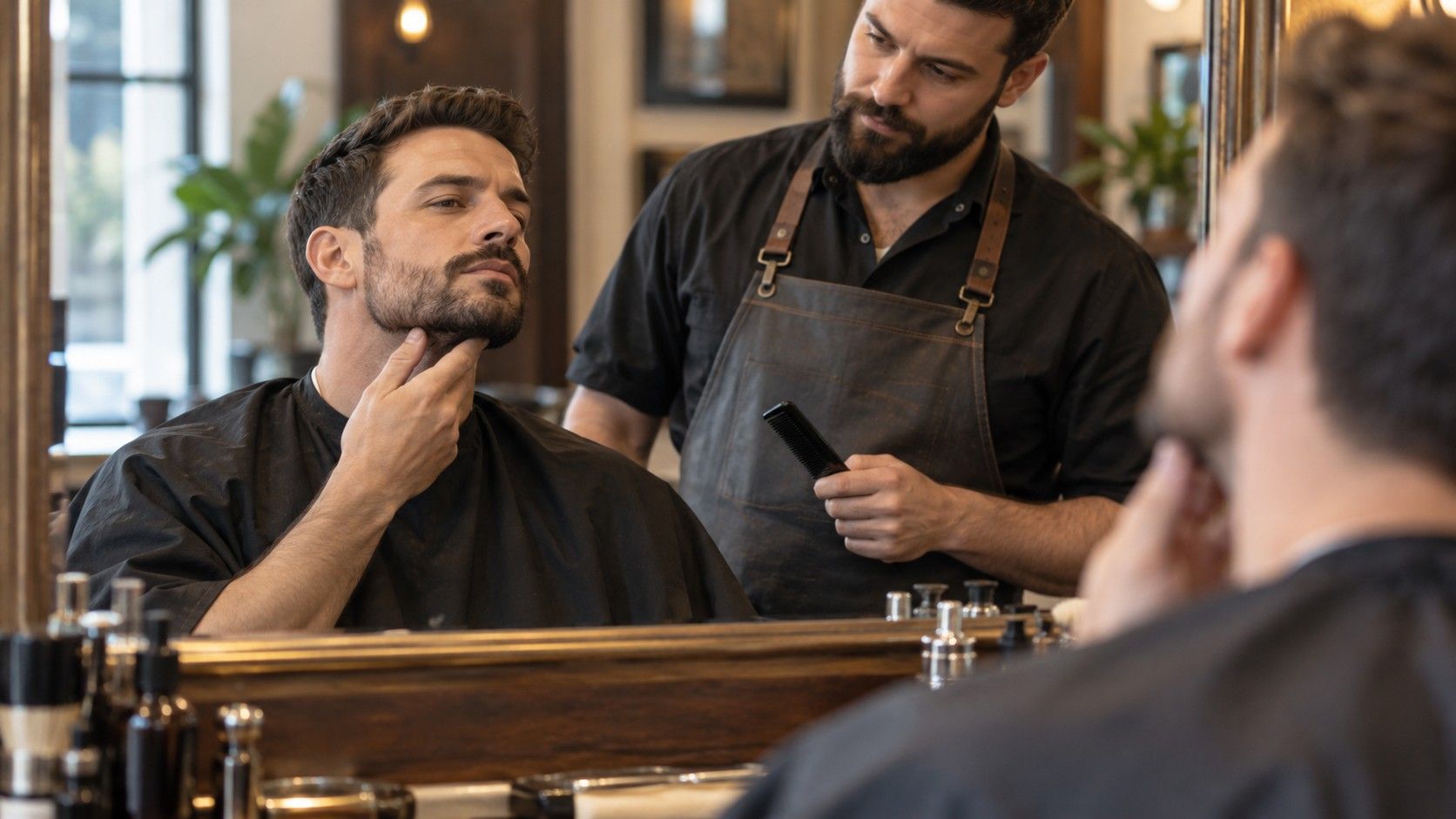
A beard changes the visible boundary of the lower face, sometimes enough to make a face-shape calculator describe the hair instead of the jaw underneath. That can be useful when you choose the effect deliberately. Before searching for the best beard for face shape, decide whether you want more apparent length, more width or a clearer edge. Then work with the growth you have and compare the result from more than one angle. A geometric label cannot tell you how densely your cheeks grow or how much trimming you want to do.
Choose whether you want more length, width or definition
Look at your present beard with the hair dry and sitting naturally. Notice where it extends beyond the skin outline: under the chin, beside the jaw or high on the cheeks. Extra length beneath the chin tends to extend the lower silhouette, while bulk at the sides can make it look broader. The effect depends on density and the shape of the ends, so assess the visible result instead of assuming a particular guard setting will create it.
If you want a longer-looking outline, retaining some chin length while controlling the sides is an option to test. If you already feel the face looks long, compare a shorter chin with more even side volume. A square-looking beard can create a clearer lower corner; a rounded finish makes a softer transition. None of these is mandatory for a round, oval or oblong face. Decide which feature you want to emphasize before choosing the cut.
Take a front photograph at roughly face height, then a three-quarter view and a side view. The front can conceal a large projection beneath the chin, while the profile may reveal an abrupt step between the jaw and neck. I would keep the first photo as a baseline and change one area at a time. Once several areas are cut shorter, it becomes harder to tell which change altered the proportions.
Do not mistake beard shaping for a change to the jaw itself. You are arranging hair around a three-dimensional contour, and lighting will affect the apparent sharpness. Check the result in soft daylight as well as the bathroom mirror. A dramatic shadow under a ceiling light can disappear as soon as you step outside.
Balance the cheek line with side volume
The cheek line controls how much beard is visible above the jaw area. Keeping more natural coverage can connect the sideburns with the lower beard, while a lower carved line exposes more cheek. Before defining it, look at the density on both sides. A sharply drawn high line may be difficult to maintain where growth is sparse, and making the denser side match every gap on the other side can remove more coverage than you intended.
Start by removing only isolated hairs well above the main growth if you want a subtle cleanup. Step back from the mirror between passes. A line that looks slightly uneven close up may look natural at conversational distance. Repeatedly lowering each side to match the other can turn a small adjustment into a much narrower beard.
Side volume is a different control from the cheek line. You can keep a relatively full cheek area yet reduce bulk near the jaw corner, or retain a broader lower outline with less coverage above it. Brush the hair into its normal resting direction before judging the width. Flattening it tightly with your hand and trimming to that compressed shape may leave unexpected gaps once it springs back.
Compare the beard with your haircut too. Closely cropped hair at the temples can make the jaw look broader by contrast, while fuller side hair can connect the upper and lower silhouette. If you change both at a barber visit, describe the complete effect you want. “Less width at the jaw corners, with some fullness above” gives a clearer direction than naming a face shape alone.
Set a neckline that works when your head is relaxed
A neckline should be judged with your head in its ordinary position, not only with the chin lifted toward the mirror. Tilting back stretches the neck and changes the boundary you see. Mark a conservative starting area, lower your chin and check from the front and side before removing more hair. If you cannot see the underside comfortably, a second mirror or help from a barber is more useful than guessing.
There is no fixed finger-width formula that places the right line on every neck. Jaw position, neck contour, beard length and the desired finish all affect it. A very high line can expose the underside of the jaw when you move, while a low, heavy boundary may add bulk you did not want. Leave enough hair for a gradual transition and adjust in small steps rather than carving a final edge immediately.
For a short beard, a neat transition into the neck can make the outline easier to read. A longer beard may cover much of that area, so cutting too high underneath can affect its support and fullness. Look at how the beard hangs before making a neckline designed for a much shorter style. The appropriate boundary is the one that works with the current length and your usual head position.
Check comfort as part of the decision. A close finish that repeatedly feels uncomfortable is a poor maintenance plan, however neat it looks in a photograph. Use clean equipment as directed by its maker and avoid repeatedly passing over the same spot to chase perfect symmetry. You can choose a softer edge or a less close finish without losing the intended overall shape.
Adapt the plan to sparse areas and different growth directions
Coverage is rarely uniform. The chin may grow densely while the cheeks remain lighter, or one side may curl outward more strongly. Assess the actual distribution instead of choosing a dense full-beard reference and trying to cut your way toward it. A shorter style can make differences less conspicuous; in other cases, some additional length may overlap a small gap. Test rather than promising yourself that time will fill every area.
Hair direction changes how a trimmer behaves. The same guard can leave a different visible length when used with the grain or against it. Begin conservatively, follow the equipment instructions and check the result after a small pass. If you change technique halfway through, an apparent asymmetry may come from the cut rather than your underlying growth pattern.
Bring a barber photos of your own beard from the front and sides, plus a reference that shows the effect you like. Ask which parts are achievable with your coverage and how the style will look between appointments. A shape that relies on daily line work may be wrong for someone who trims once a week. Maintenance is part of the design, not an inconvenience to discover afterwards.
| Your preferred effect | Area to compare | What can undermine it |
|---|---|---|
| More apparent length | Chin length relative to side bulk | Adding length that projects awkwardly in profile |
| A broader lower outline | Volume near the jaw corners | Sparse sides or hair that flares unpredictably |
| A cleaner edge | Cheek and neck transitions | Cutting too far while chasing symmetry |
| An easier routine | Natural boundaries and shorter lengths | Choosing a style that needs frequent precise carving |
Check the outline as it grows, before cutting again
Reassess after washing and drying the beard in your usual way. Damp hair can sit flatter or appear longer, while brushing and product can change the silhouette. Compare like with like: similar light, similar head position and dry hair at rest. Use the same camera distance so a close selfie does not introduce a new proportion change into the comparison.
When assessing beard jawline proportions, note the feature that actually needs adjustment. Perhaps the chin has become too pointed, one side flares outward or the neckline looks abrupt in profile. Correct that area conservatively. Trimming the whole beard every time one edge looks untidy can keep removing the length you were trying to establish.
Keep a short record of the technique and settings that gave you a comfortable result, while remembering that guards and tools differ. A photo can be more useful than the number alone. Show it at the next appointment and explain what you liked after several days of wear, when the outline had settled into daily life.
You do not need an obscured face-shape measurement to decide whether the beard suits your preferences. Look at the complete head and shoulders, turn sideways and move naturally. If the beard feels manageable and gives you the length, width or softness you wanted, it has done its job. The underlying shape label can remain uncertain.